



For decades, progress in technology was loud.
More screens.
More buttons.
More notifications.
More features.
We learned to measure innovation by visibility — what we could see, click, customize, and control. Software demanded attention. Hardware demanded interaction. And we accepted that friction as the price of progress.
But somewhere along the way, something changed.
By the end of 2025, the most discussed question in technology circles is no longer “What can software do?”
It’s “Why does it still need to feel like software at all?”
“The most powerful technology is the one you no longer notice.”
The Fatigue Nobody Planned For
We didn’t realize we were getting tired — until we were exhausted.
Users are overwhelmed by dashboards.
Teams are drowning in tools.
Decision-makers are buried under alerts, reports, and systems that require constant supervision.
Technology didn’t fail.
It overperformed.
And now, people want something radical:
Technology that steps back.
Not weaker.
Not simpler.
Just… quieter.
From Interfaces to Presence
The next evolution of software isn’t visual.
It’s ambient.
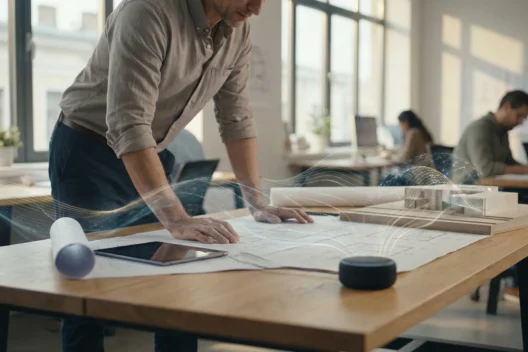
Invisible technology doesn’t ask users to interact — it adapts.
- Apps anticipate needs instead of requesting inputs
- Systems respond to context, not commands
- AI runs quietly in the background, making micro-decisions
- Interfaces disappear into environments
This is why concepts like ambient computing, spatial intelligence, and context-aware AI are gaining traction.
Because the future doesn’t want more screens.
It wants less interruption.
Why This Shift Is Happening Now
Three forces are converging:
1️⃣ AI Has Matured
AI no longer needs constant human instruction. It can infer, learn, and adjust — making visible interfaces optional.
2️⃣ Hardware Has Blended In
Sensors, wearables, edge devices and IoT systems have embedded computation into physical spaces.
3️⃣ Humans Have Reached Cognitive Limits
Attention is finite.
Designs that demand it aggressively are losing trust.
The result?
Technology that hides itself is no longer a luxury — it’s a necessity.
The Emotional Truth Behind Invisible Tech
There’s something deeply human about this shift.
We don’t want to manage technology anymore.
We want to live.
Invisible technology feels respectful.
It doesn’t interrupt conversations.
It doesn’t ask for constant validation.
It doesn’t shout for relevance.
It supports without demanding presence.
And in a world already full of noise, that feels revolutionary.
The Hidden Complexity Behind Simplicity
Here’s the paradox most people miss:
Invisible technology is harder to build than visible technology.
Because when systems disappear:
- Errors must be prevented, not explained
- Decisions must be correct, not adjustable
- Data pipelines must be flawless
- AI models must be trustworthy
- Infrastructure must be resilient
- Security must be silent but absolute
There is no “undo” button when users don’t see the system.
Invisible tech requires more intelligence, not less.
What This Means for Businesses
The companies that will lead in 2026 won’t win by shipping more features.
They’ll win by:
- Reducing friction
- Designing for context
- Building systems that feel intuitive
- Investing in backend intelligence
- Prioritizing trust over control
The real competitive edge will be experience without effort.
Conclusion: When Technology Learns to Step Aside
Software is evolving — not into something bigger, but into something calmer.
The most advanced systems of the future won’t ask users to adapt.
They’ll adapt themselves.
And when technology finally stops feeling digital…
that’s when it becomes truly human-centric.
At AMHH, we design intelligent digital systems that work quietly in the background — from AI-driven platforms to context-aware web and application solutions.