




Trust is one of the most fragile yet powerful forces in human life. We trust pilots to fly us safely, doctors to heal us, and institutions to protect our money. But what happens when trust shifts from people and institutions to machines and algorithms?
This is the great question behind blockchain. It challenges centuries of habit, asking us to believe not in banks or governments, but in lines of code and decentralized consensus.
“Trust takes years to build, seconds to break, and forever to repair.” — Unknown
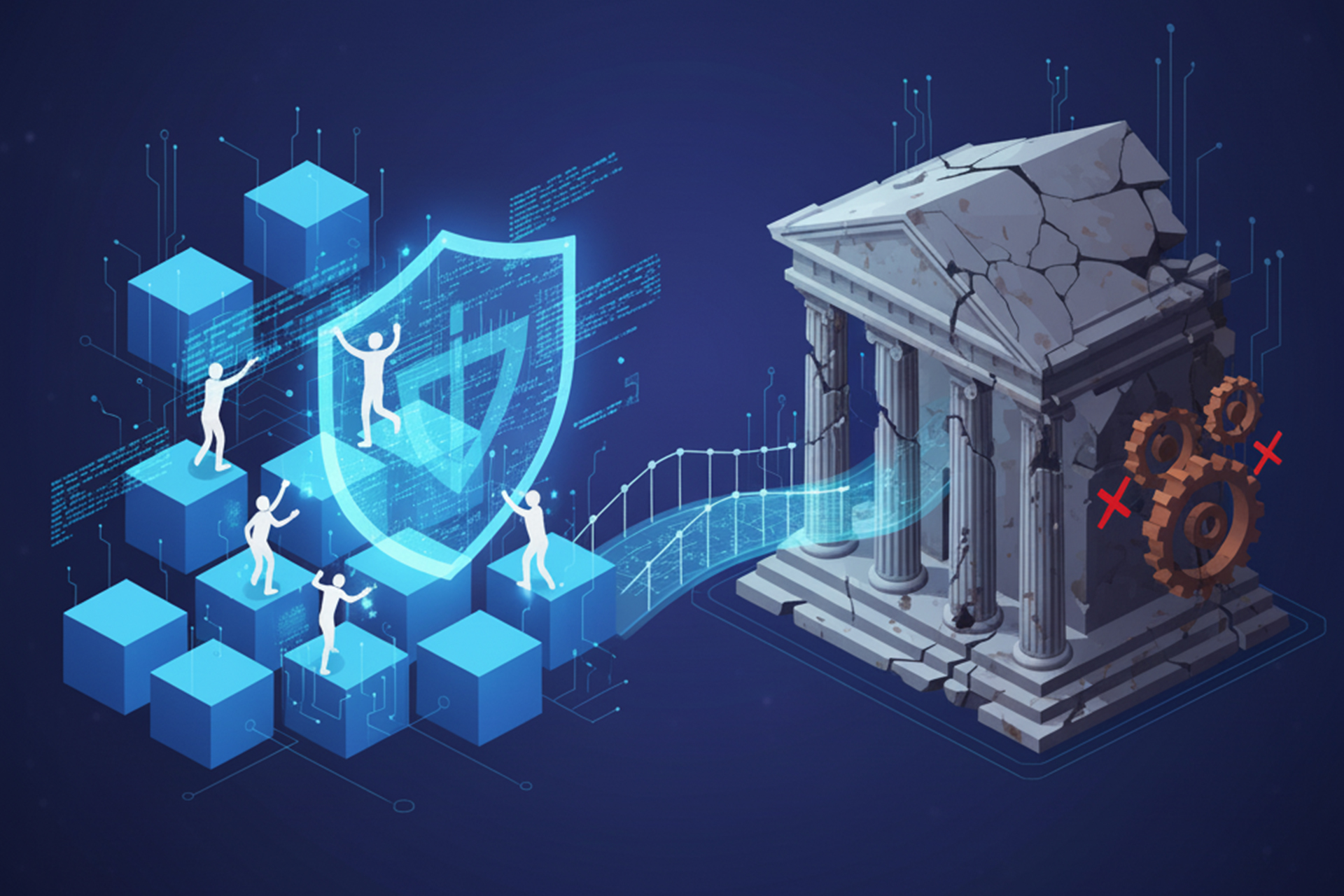
The Cracks in Centralized Trust
Traditional trust is fragile because it depends on authority. A bank can fail. A government can falter. A corporation can manipulate. And when one fails, millions suffer.
Consider this:
- In 2008, the global financial crisis erased $2 trillion in global wealth in just a few months.
- Cross-border payments remain painfully inefficient, taking 3–5 business days with fees averaging 6% (World Bank, 2023).
- Centralized databases, no matter how advanced, remain vulnerable to breaches—over 422 million accounts were exposed to data leaks in 2022 (ITRC).
Trust, in its centralized form, is a single thread—easy to snap.
Blockchain’s Promise of Shared Trust
Blockchain doesn’t eliminate trust—it distributes it. Instead of one fragile thread, it weaves a web. Every transaction is verified by consensus, stored immutably, and visible to all.
- Bitcoin secures about 350,000 transactions daily, all validated without a single central authority.
- Ethereum processes around 1.2 million daily transactions, with blocks confirmed in about 12 seconds.
- Once recorded, altering data on a blockchain would require re-mining every subsequent block—mathematically near impossible on large networks.
This isn’t blind faith; it’s mathematically enforced reliability.
Beyond Currency — Human Trust in Action
Blockchain isn’t just about digital coins; it’s about reshaping how we trust.
- Supply Chains → Imagine knowing exactly where your food came from. IBM and Maersk’s TradeLens tracked 30 million shipments before 2023, cutting fraud and delays.
- Healthcare → European pilots use blockchain to keep patient records safe—reducing errors and ensuring privacy.
- Voting → Estonia experimented with blockchain-backed voting to strengthen democracy through transparency.
Each of these examples reveals a deeper truth: blockchain doesn’t just create digital efficiency—it restores human confidence in systems long plagued by doubt.
The Shadows of Decentralization
But no technology is flawless. Blockchain itself faces doubts:
- Scalability → Bitcoin manages 7 TPS, far below Visa’s 24,000 TPS.
- Energy → Bitcoin’s energy use hit 91 TWh in 2022—comparable to Pakistan’s annual consumption.
- Regulation → Without legal clarity, adoption stalls.
These challenges remind us: trust is not only about math; it’s about perception. If people feel blockchain is too slow, too wasteful, or too uncertain, the emotional bond breaks.
The Human Side of Digital Trust
Ultimately, trust is emotional. For centuries, a seal, a handshake, or a signature carried weight. Now, blockchain asks us to put faith in invisible ledgers and anonymous miners.
For people to truly trust blockchain, it must be more than secure. It must be understandable, relatable, and accessible. Technology alone is not enough—human connection must be part of the equation.
“People don’t buy what you do; they buy why you do it.” — Simon Sinek
Conclusion: A Web of Trust for a New Era
Blockchain is not about destroying trust but rebuilding it on a new foundation. By weaving a net instead of a single thread, it makes trust stronger, harder to break.
At AMHH, our Blockchain Development services are built on this vision—combining technical rigor with the human need for clarity, transparency, and confidence in the digital age.