


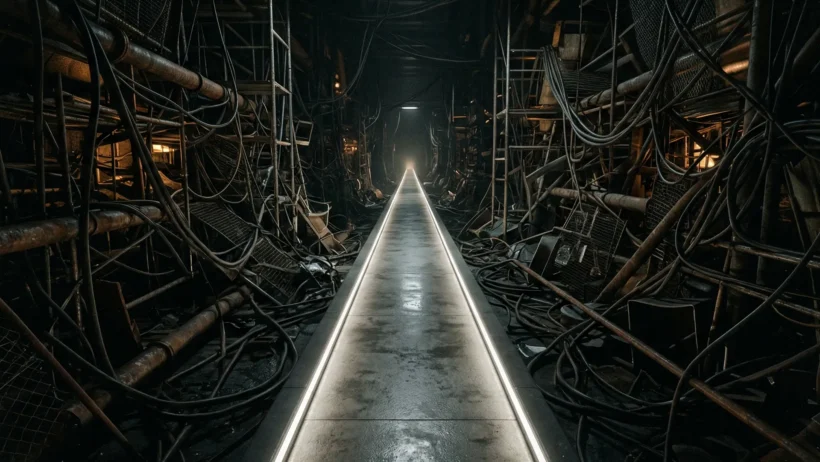

There is a quiet pattern in the digital world that becomes visible only after spending enough time inside it. The products that truly succeed are rarely the ones with the most features. They are the ones that feel the easiest to understand, the ones that do not make the user stop and think before acting.
Complexity Is Easy to Build
Modern technology has removed most of the barriers to adding new features. A new integration can be implemented quickly, dashboards can expand almost endlessly, and customization options can grow without clear limits. From a development perspective, complexity is no longer difficult to create; in many ways, it is the natural direction of growth.
Yet as products evolve, they begin to accumulate layers that make sense internally but become harder to navigate externally. What starts as a solution slowly turns into something that needs explanation, and once a product needs explanation, it has already lost part of its clarity.

The Illusion of More Value
There is a long-standing assumption in product thinking that more features create more value. On paper, this seems logical, but users rarely experience value as a list of capabilities. They experience it through interaction.
When a product introduces hesitation, forces users to search for the next step, or creates even small moments of confusion, its perceived value starts to decline. Complexity often hides value instead of enhancing it, turning potential strength into friction.
In practice, users respond more strongly to products that feel:
- Immediately understandable
- Predictable in behavior
- Effortless to navigate
This is not about reducing functionality. It is about presenting it in a way that feels natural.

Simplicity Is a Decision, Not a Default
Simple products are rarely simple by accident. They are the result of deliberate choices, often difficult ones. Building simplicity requires knowing what to remove, what to delay, and what to never include at all.
This process depends on a few critical factors:
- a clear product vision
- a deep understanding of user behavior
- the discipline to say no to unnecessary features
Simplicity is not the absence of capability; it is the outcome of intentional reduction.
The Cognitive Cost of Digital Products
Every product asks something from its user: attention, time, and mental effort. When these demands increase, so does the cognitive load. Over time, this cost becomes more important than the feature set itself.
Users rarely articulate this directly. Instead of complaining, they disengage. Many digital products do not fail loudly; they fade out of use, replaced by alternatives that feel easier to operate.
This is why clarity is not just a design concern. It is a retention strategy.
The Shift Toward Clarity
A noticeable shift has emerged in recent years. Users are becoming more selective, not because they want fewer tools, but because they want tools that demand less effort.
They gravitate toward products that:
- Reduce decision-making
- Guide without overwhelming
- Feel stable and consistent
This shift does not signal a rejection of technology. It reflects a growing preference for clarity over complexity.

Simplicity as a Competitive Advantage
In a crowded digital landscape, simplicity has become more than a design philosophy. It is now a strategic advantage. Products that are easier to understand reduce onboarding time, improve user retention, and build trust more quickly.
They also create a subtle but important effect: users feel in control. That sense of control strengthens long-term engagement in ways that feature-rich systems often fail to achieve.
The Hidden Role of Systems
What appears simple on the surface is often supported by carefully designed systems underneath. Data flows are structured, integrations are managed quietly, and complexity is absorbed before it reaches the user interface.
When this layer is missing, complexity leaks outward. The user becomes responsible for navigating decisions that should have been handled by the system itself. This is where many products lose their balance.
Conclusion
Complexity will continue to grow as technology advances. That part is inevitable. The real difference lies in where that complexity exists.
The most successful products are not the ones that eliminate complexity, but the ones that manage it carefully and keep it out of the user’s way. In a world where digital systems are becoming increasingly sophisticated, simplicity is no longer a luxury.
It is the clearest signal of a well-designed product.
At AMHH, we design digital products that combine strong technical foundations with intuitive user experiences, ensuring that complexity remains behind the scenes while users interact with clarity and ease. Explore our Web and App Development Services to build products that truly work.